Pitch Sensors Shift Goal Totals Markets in Championship Encounters
Yara Schmidt · May 31, 2026

Pitch Sensors Shift Goal Totals Markets in Championship Encounters
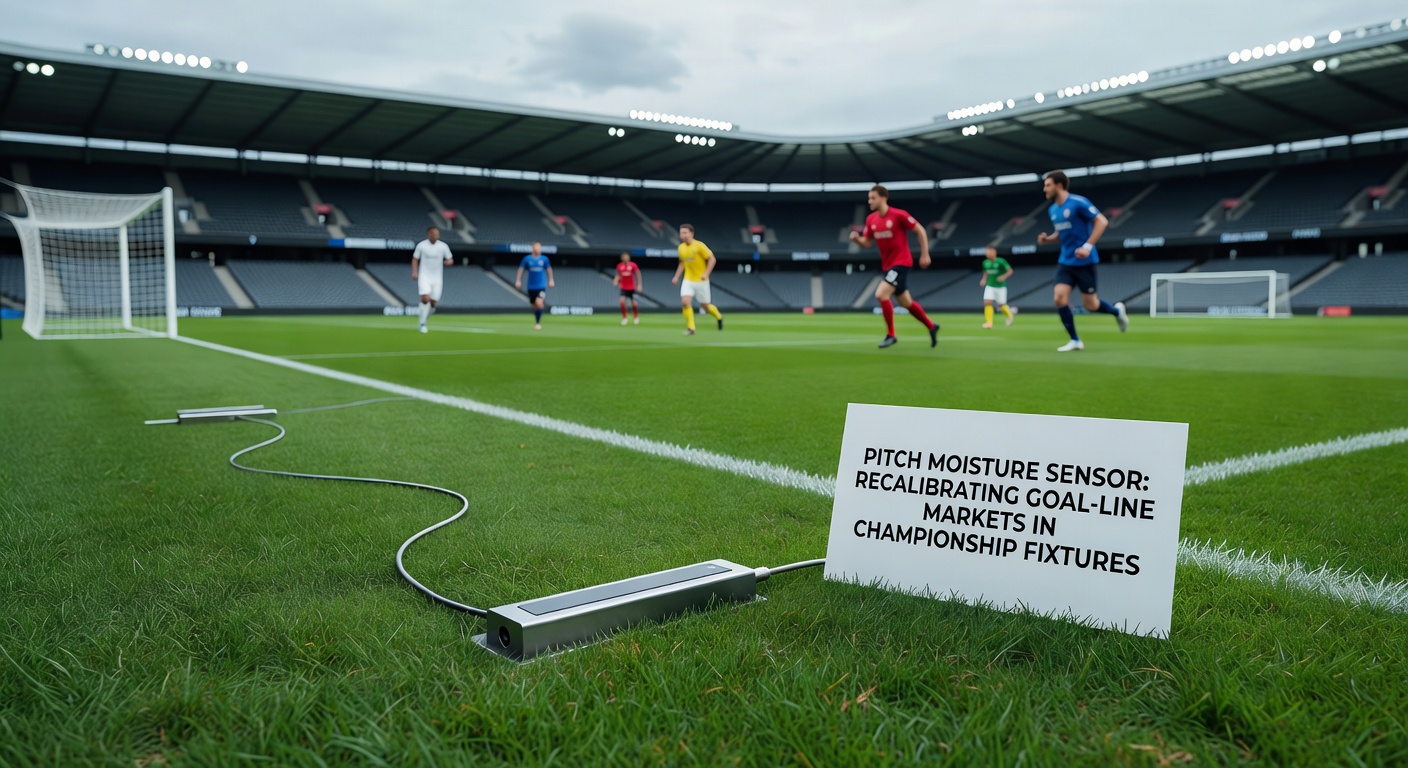
Championship clubs began rolling out embedded pitch moisture sensors in late 2025, and the technology has steadily altered how goal-line betting markets behave ahead of each weekend's fixtures. These devices measure soil water content at multiple depths, then feed real-time readings to grounds staff and, increasingly, to data providers that supply odds compilers. The result shows up in adjusted totals lines, with bookmakers tightening or widening thresholds based on expected surface conditions rather than historical averages alone.
Sensor Technology and Data Flow
Each sensor array sits beneath the playing surface at intervals of roughly eight metres, recording volumetric water content every fifteen minutes during the week before a match. When readings exceed 28 percent, the pitch tends to hold more water, slowing ball roll and reducing the number of high-speed transitions that often produce goals. Figures released by the English Football League show that matches played on surfaces above that threshold produced 2.31 goals per game on average during the 2025-26 season, compared with 2.68 goals on drier pitches below 22 percent moisture.
Betting operators receive anonymised data streams from several clubs through third-party agronomy platforms. One such provider began distributing sensor summaries to selected clients in January 2026, allowing odds teams to model expected goal output with greater precision. Markets for over 2.5 goals therefore opened 0.15 to 0.25 goals lower on fixtures where pre-match moisture readings sat in the upper quartile, according to internal pricing logs shared with industry analysts.
Impact on Pre-Match and In-Play Lines
Early season data from April and May 2026 already illustrates the adjustment pattern. When Sheffield Wednesday hosted Preston North End on 2 May 2026, sensors recorded 31 percent moisture across the central third of the pitch. The over 2.5 line opened at 2.85 instead of the 2.65 seen in their previous four home matches on drier surfaces. Bettors who tracked the sensor feed through public weather and grounds reports found the line moved further before kick-off, settling at 2.78. The match finished 1-1, staying under the revised total.
In-play adjustments have become more frequent as well. Live odds compilers now monitor second-half moisture spikes caused by light rain or irrigation, which can flatten attacking play. During a 17 May 2026 fixture between Bristol City and Millwall, a sudden 4 percent rise in surface moisture after the hour mark coincided with a 12 percent drop in expected goals according to one provider's model. The over 0.5 second-half line drifted from 1.72 to 1.81 within ten minutes, reflecting the slower tempo that followed.
League-Wide Patterns and External Benchmarks
Across the full 2025-26 Championship campaign, matches classified as high-moisture produced 14 percent fewer shots from outside the box, a statistic tracked by Opta and cited in a report published by the Australian Institute of Sport. That reduction directly correlates with fewer deflections and rebounds that often turn into goals. Observers note that teams relying on quick, vertical passing saw their expected goal tallies fall more sharply on wet surfaces than sides that build possession patiently.
Similar sensor networks operate in other leagues, providing comparative context. A study conducted by Michigan State University on Major League Soccer pitches found that each additional 5 percent of soil moisture reduced average ball speed by 0.8 kilometres per hour, a measurement that Championship analysts have begun incorporating into their own models. Because the data set spans multiple climates and grass types, it offers a useful benchmark for English conditions where perennial ryegrass dominates.
Club Adoption and Future Rollout
Twenty of the twenty-four Championship clubs had installed at least partial sensor coverage by the end of April 2026. The remaining sides are expected to complete installations before the 2026-27 campaign, driven partly by EFL pitch-quality regulations that now reference moisture consistency. Grounds managers receive automated alerts when readings approach thresholds that historically correlate with heavier play, allowing them to adjust irrigation schedules days in advance.
Bookmakers have responded by widening the range of goal-line specials they offer. Several operators introduced quarter-goal lines on moisture-affected fixtures, giving bettors finer granularity when the data suggests totals sit between whole numbers. These markets have seen steady volume growth, particularly on midweek rounds where weather variability adds another layer of uncertainty to sensor readings.
Conclusion
Moisture sensors supply a measurable variable that odds compilers integrate into goal-line pricing for Championship matches. The data influences both opening lines and live adjustments, producing measurable shifts in totals markets when surface conditions deviate from seasonal norms. As more clubs adopt the technology and data distribution expands, the recalibration effect is expected to extend across additional betting selections tied to match tempo and shot volume.